miércoles, 21 de enero de 2015

January 21: The French Convention decreed the guilt of Louis XVI for treason, and sent him to the executioner beheaded by the guillotine, in 1793.


The King of France, Louis XVI, escaped in disguise to seek help abroad, because he did not support the National Convention, which imposed the expropriation of the lands of the Catholic Church throughout France.


Marie Antoniette and Louis XVI


After the legal exercise to determine the flight of the king to the outside, finally, the Convention decided to blame the King Louis XVI and sentence him to the guillotine, the execution took place on January 21, 1793.


Arrest of Louis XVI and his family at Verennes in 1791

Relations between the Catholic Church and the French Revolution deteriorated in such an extent that in February 13, 1790, all religious orders were suppressed and in July 12, called to a Civil Constitution of the Clergy which removed 51 dioceses and 4,000 parishes approved . The Pope became angry.

Arrest of Louis XVI and his family at Verennes in 1791

Bishops and priests would be elected by the National Assembly, not the Catholic Church. Then they issued a decree ordering all clergy to swear in favor of the Constitution, which produced a polarization: the sworn and refractory, faithful to Pope Pius VI who condemned the Constitution. Refractory is one that is dogmatized, indoctrinated and impregnable. Louis XVI had to punish the law under pressure.


The trial of Louis XVI

The king broke down and decided to flee Paris with his family to seek the intervention of friendly powers, such as the Holy Roman Empire, based in Vienna. His wife was Austrian and whom the French Revolution nicknamed "Madame Deficit" for his lustful addition to jewelry. Indeed, recall that Marie Antoinette was of the house of Habsburg, daughter of the emperors of Austria, Franz I and Maria Theresa of Austria.


Louis XVI -Saying Good-Bye to the Children


The brothers of King Louis XVI and other migrants belonging to the nobility and the higher clergy were conspiring from abroad and particularly from the city of Koblenz (now Germany).


Louis XVI

martes, 20 de enero de 2015

January 20: The Portuguese army defeated the French at the Battle of Rio de Janeiro in 1567 and expelled them from Brazil.


Estacio de Sá (1520-1567), also known as Mem de Sá was a soldier and officer of the Portuguese army at the time of the conquest of Brazil. He became Governor-General of Portuguese colony of Brazil.

Map of France Antarctique in the Guanabara Bay, 1555.


The French had established themselves at Gunabara Bay in Rio de Janeiro. They named the place as French Antartic in order to establish a French colony there.The French commander who led the colonists was Nicolas Durand de Villegaignon.


Recent map of the State of Rio de Janeiro


Mem de Sá was sent back to Brazil, as commander of the Portuguese troops to shed off the French colonizers from Rio de Janeiro. In fact, the Portuguese, in far smaller numbers, managed to defeat the French and make them run to the jungle. The French town was then burnt by Mem de Sá, the Portuguese governor.

Sá won the battle; however, he was hit by an arrow pierced his eye and sent him to the grave, one month after winning the Battle of Guanabara, also known as the Battle of Rio de Janeiro, from January 20, 1567.

lunes, 19 de enero de 2015

January 19: The Batavian Republic was proclaimed in 1795 where today is Holland, as part of the Netherlands.


                                 William V of Orange-Nassau


Since 1778 in the United Provinces (Netherlands) the presence of a patriotic party was consolidated that looked immersed in the ideas of the French Enlightenment in the second half of the century XVIII.


          Departments of the Batavian Republic


In the context of the crises of the 1780s, the Dutch patriots managed to mobilize the masses in urban militias, reaching great power throughout the country, so the stadtholder William V of Orange-Nassau was forced to leave the Hague.


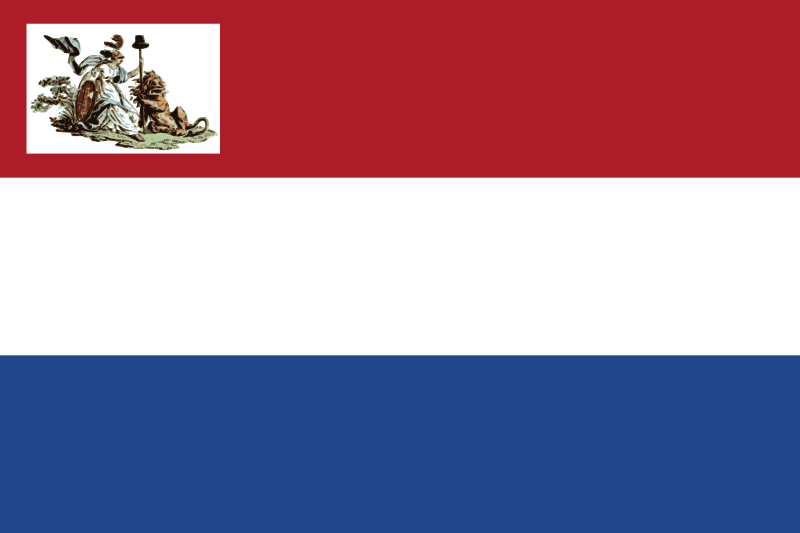
                                  Flag of Batavian Republic (1795-1806)


Batavia means the land inhabited by the Batavian people during the Roman Empire where today is part of the Netherlands.


Coat of Arms: Mascot of the Batavian Republic and Maiden, representing the United Provinces of Netherlands.


The new republic was formed with the support of the French Revolution and thus became a “client state” of France. It was also the first of the so called “sister-republics” under Napopleon Bonaparte´s rule.


Dutch Maiden on a design for the The Golden Carriage, by Nicolaas van der Waay. 

domingo, 18 de enero de 2015

January 18: The January 19, 1871, Wilhelm I of Prussia was crowned Emperor of the Second Reich, in the Hall of Mirrors in Versailles Palace.


                                        Napoleon III surrenders his sword to Otto von Bismarck, Prussian Chancelor. 


Napoleon III, suspicious and fearful by the Prussian victory over Austria and its allies, in 1866, wanted to prevent Prussian expansion to rival French prestige and power.

The German nationalism was leaning towards Prussia, by victories over Denmark and Austria.


Napoleon III having a conversation with Otto von Bismarck after being captured in the Battle of Sedan
                                                      painting by Wilhelm Camphausen. 


In 1868 there was a revolt in Spain, known as "La Gloriosa" that overthrew Queen Elizabeth II, who had been ruling over Spain since 1833. A joint provisional government offered the Spanish throne to Prince Leopold of Hohenzollern-Sigmaringen, belonging to the dynasty that ruled Prussia. Napoleon III increased its jealousies and fears wound to be among the Prussians.

The convergence of leadership in politics and diplomacy by Bismarck, left, reorganization of the army and its training techniques by Albrecht von Roon  (center), and the redesign of operational and strategic principles by Helmuth von Moltke (right) placed Prussia among the most powerful states in European affairs after the 1860s.


Napoleon III asked his ambassador in Berlin, Vincent Benedetti, to visit the King of Prussia, who was at the spa Ems, that summer of 1870.

The Prussian King Wilhelm I declined the demands of Ambassador Benedetti and then sent a telegram to his Chancellor Otto von Bismarck, who was in Berlin. The Prussian Chancellor, upon receiving the message, found an opportunity to modify it and send it to the government of France. This episode is known as the "Ems Dispatch".


William I is proclaimed German Emperor in the Hall of Mirrors in Versailles, France.Painting by Anton von Werner. 


The result was that Napoleon III showed the telegram and made it public to the people of Paris, who immediately shouted "all to Berlin". Napoleon III declared war on Prussia on July 19, 1870. On September 2, 1870, Napoleon III and 100,000 of its soldiers were taken prisoners by the Prussian Army, commanded by General Helmuth von Moltke, at the Battle of Sedan.


                                      The German Empire of 1871–1918.


Bismarck was right at achieving victory over France, which had become a common enemy for almost all the states of the German Confederation which were unified around Prussia. As a result, Wilhelm I of Prussia was crowned emperor of the Second Reich, in the hall of Mirrors in Versailles Palace: Deutscher Kaiser in German, in January 18, 1871.


Member states of the German Empire (peach), with Kingdom of Prussia shown in blue.


Otto von Bismarck was the Minister President of Prussia and Chancellor of the North German Confederation and who offered the title of "Emperor of Germany or Kaiser" to the Prussian King Wilhelm I.

 German Emperor Wilhelm I


The First Reich was the Holy Roman Empire dissolved in 1806 by Napoleon I (Bonaparte). The title of Kaiser, was copied from the Czar of Russia, which in turn took the name from the Roman emperor Caesar.

sábado, 17 de enero de 2015

January 17: Today is the anniversary of the great division of the Roman Empire in 395 AD, with the death of Emperor Theodosius I.


Saint Ambrose and Emperor Theodosius by Anthony van Dyck.  


The death of Emperor Theodosius in Milan, divided the empire into two factions:

1. Western Roman Empire, based in Mediolanum, Milan today, and commanded the brother of Theodosius, called Honorio 10 years of age.

2. Eastern Roman Empire, also called Byzantine Empire, based in Constantinople, under the command of the eldest son of Theodosius, Arcadius and called who was born in Hispania.


Map of the partition of the Roman Empire in 395, at the death of Theodosius I: the Westwrn  is shown in red and the East Roman Empire or Bizantine Empire  is shown in purple


Count Theodosius, also called "Theodosius the Great" was born in Cauca, Hispania, in 346, and died in Milan in 395. He learned to fight the British in Britain, and then went as Duke of Mesia in today's Serbia. After the execution of his father, Emperor Gratianus appointed defender of Mesia before the invasion of the Goths (Germanic barbarians from the east, but Viking origin).

                          The two Roman Empires (East and West), 395 A.

Gratianus was also of Hispanic origin, seized the Eastern Empire and called Theodosius to help him implement Christianity as "universal" religion. Gratianus was beheaded by order of General Maximus, also Hispanic and Teodosio relative who was crowned emperor of the East on January 19, 379, with the title of Augustus.


Rome, Western Roman Capital, and Constantinople, East or Byzantine Empire


viernes, 16 de enero de 2015

January 16: The Roman Senate gives Gaius Octavius Caesar the title of Augustus in 27 BC which starts the Roman Empire.


Statute of Augustus

Commonly called Octavius, was born with the name of Gaius Octavius within a wealthy family of the equestrian line. He was adopted by his maternal grandfather uncle Gaius Julius Caesar, who favored him to build relationships in Rome and its environs. With the assassination of Julius Caesar, Octavius managed to win favoring military and Roman soldiers for their good treatment and leadership. Along with Anthony and Lepidus, he formed the Second Triumvirate of Rome, a military dictatorship. Lepidus was killed and Anthony committed suicide after losing his last battle.


Extent of the Roman Empire under Augustus. The yellow legend represents the extent of the Republic in 31 BC, the shades of green represent gradually conquered territories under the reign of Augustus, and pink areas on the map represent client states. However, areas under Roman control shown here were subject to change even during Augustus' reign, especially in Germania.  


Octavius came to have the majority of Roman military power represented in the Legions of Rome which was potentially threatening to the Senate in cases of senatorial opposition to Octavians. Republicans regained Rome principles by which political power resided in the Senate. But with so much power to have absorbed all the titles that gave Rome, including consular, the Senate resolved to please him extol and venerate. Hence, Senate granted him the title "Augustus" which literally means "Venerable". That honor led to his new name which became “Gaius Julius Caesar Augustus” who provided stability to Rome and achieved what is known in history as the Pax Augusta or more commonly as the Pax Romana.

jueves, 15 de enero de 2015

January 15: The French king Francis I colonized New France in Canada in 1541.


The French King Francis I commissioned corsair Jean-François de La Rocque de Roberval to establish the province of New France in Canada, and ensured to impose and spread the “Holy Catholic Faith”. The chief navigator was Jacques Cartier because of his previous two trips to Canada. The competition then was for the Catholic power in the sixteenth century, which was growing against the Holy Roman Empire of the Hapsburgs of Austria and Spain.


 First settlement of New France


To counter the Catholic Habsburg power under Emperor Charles V, especially for its control over all Spanish territories in the New World of America, the French king undertook a plan of colonization in North America and Asia. Therefore, he sent fleets of ships to achieve its objectives, among which was the contact with the Turkish-Ottoman Empire to develop trade in the Mediterranean Sea and realize a strategic military alliance.


King Francis I received the citizens of Lyon who wanted to finance an expedition given by Giovanni da Verrazzano for North America. The king liked the idea, and Verrazzano left to America. When he landed in Canada claimed Newfoundland for the French crown. He also founded New Angoulême, where is currently the city of New York.