miércoles, 22 de julio de 2015

July 22: Today is the anniversary of the Act of Union between the Kingdom of England and the Kingdom of Scotland, which is to be approved by both parliaments, leading to the creation of the United Kingdom of Great Britain, in 1707. (This was the early integration of the British island)


The Act of Union that created the United Kingdom of Great Britain


Wales had already been absorbed by King Henry VIII in 1536, without objection.

During the course of the "War of Spanish Succession" a desired of union between the two kingdoms in Britannia was imminent. We recall that the Romans called Britannia what is today Great Britain.

For over one hundred years the English had proposed marriage to Scotland. Many will remember the struggles of the Scottish rebel William Wallace in the movie Braveheart starring and directed by Mel Gibson, which exposes the Scottish fight against English occupation of Edward I in the thirteenth century.

Navies and pirates of both kingdoms needed to navigate with one united flag. That is how it all started.

Evolution of the British flag:


Saint George flag representing England:


In 1194, Richard I of England introduced the cross of Saint George in red on a white background as the national flag of England.


Scotland is represented by the cross of Saint Andrew:


Scotland is represented by the cross of Saint Andrew: The Cross of Saint Andrew has two diagonal white lines on a dark blue background. The April 12, 1606, a royal decree declared that the British ships should carry both flags.
Finally, the 1707 Act of Union between England and Scotland merged the two crosses on a single flag to represent the United Kingdom of Great Britain:


First flag of the Union: 1707

The 1707 Act of Union brought together the kingdoms of England and Scotland with a single Parliament and a single flag, to form the United Kingdom of Great Britain.


martes, 21 de julio de 2015

July 21: Signing of the Treaty of Passarowitz between the Ottoman Empire, the Habsburg Holy Roman Empire based in Austria, and the Republic of Venice, July 21, 1718.


Map of the Banat of Temeswar, Kingdom of Serbia and Military Frontier in 1718. The central Balkans in 1718. Territories passed from the Turks to Austria were: Banat of Tameswar, Habsburg Kingdom of Serbia, Northern Bosnia, and Lesser Wallachia.

The Ottoman Turks began to invade Greek Aegean islands, continued with the Balkan Peninsula and, then Venice. But the Austrians defeated the Ottomans in the Battle of Petrovaradin, during the called Austro-Turkish war, between 1716 and 1718, known as the Third Turkish War, out of the four who had the Turks against the Habsburgs, looking forward to invade the whole Europe.


It seems that there has been controversy about the origin of the name "Balkans". The Turks say it means "Mountains" in Turkish.


The Slavs say it means "war" (Valka) that, in fact, has been the life of the Balkan people from the time of Philip of Macedonia, father of Alexander the Great.

 Giovanni Battista Tiepolo, Neptune offers the wealth of the sea to Venice, 1748-1750. This painting is an allegory of the power of the Republic of Venice, as the wealth and power of theSerenissima was based on the control of the sea.


Ahmed III


The result of the Treaty of Passarowitz (in German) is summarized in the loss of Banat, the central part of present Serbia, a strip of Bosnia and Wallachia, by the defeated Turks. The Republic of Venice gave up the Peloponnese and retained only the Ionian Islands.


A Turkish hunting party with Ahmed III. Painting by Jean-Baptiste van Mour. 


lunes, 20 de julio de 2015

July 20th: Today is the anniversary of the "Cry for Independence of Colombia" in 1810. It is the date commonly used to commemorate the Colombian Independence from Spain; but the act was signed on July 21. For some historians the Independence Day of Colombia should be held on July 21 and not the 20th.


House of Carlos Jose Gonzalez-Llorente where the Cry of Independence startaed, Bogotá July 20th, 1810.

All meetings were held in the province of Santa Fe made up of an unjust majority of Spaniards. For example, between 1808 and 1810, they involved 36 versus 9 Spanish American Creoles. Hence, the desire for independence arises from taking advantage of Napoleonic Wars in Europe that kept the Spaniards busy, unstable, distracted, and weak.


Restored House of Carlos Jose Gonzalez-Llorente where the Cry of Independence startaed, Bogotá July 20th, 1810.


In 1809 there were demonstrations of freedom in Bolivia and Ecuador demanding the creation of a nation-state to copy the system that emerged from the French Revolution.


Santamaria fight with Llorente in the northeastern corner of the Plaza Mayor today called Plaza de Bolivar.


Creoles from Cartagena and Mompós, New Granada, had already gathered together intending independence from Spain.


Colombian declaration of Independence from Spain, in 1810. "Independence" cries. The American world; In heroes' is bathing. The Land of Columbus. But this great principle: "The King is not sovereign".


A board of Creole distinguished people and intellectuals, led by Francisco Jose de Caldas, proposed creating an incident that enraged the Viceroy Antonio José Amar y Borbon, in order to have the justification of a conflict and a popular uprising. Antonio Morales suggested going to annoy the Spanish merchant José González Llorente.


July 20, 1810 was a Friday market day and, therefore, the city’s square would be full of people. The Ecuadorian commissioner Antonio Villavicencio was invited to a Creole dinner. Creoles knew that the merchant González Llorente would not pay a vase to decorate the table in response to other Creole. Therefore, uprising broke out and also the cry of independence!


domingo, 19 de julio de 2015

July 19: France declares war on Prussia on July 19, 1870.


France attempted to declare war on Russia. Due to a typographical error, however, she inadvertently declared war on Prussia and caused the Franco-Prussian war.
This eventually led to the creation of Germany, which led to World War I, World War II.


This war was motivated by two reasons: 1. The Prussian Chancellor Otto von Bismarck had angered Napoleon III, second emperor of France, who held in usufruct the prestige of Bonapartism. When Bismarck was uniting Prussia, he had to declare war on Austria which was defeated in seven weeks. Napoleon III wanted to take advantage by "being neutral" and asked territories as a compensation. In addition, Napoleon had just failed in his attempt to annex Luxembourg.


Collage of Franco–Prussian War imagery


Moreover, in 1868 there was a revolt in Spain, known as "La Gloriosa" that overthrew Queen Elizabeth II. A joint provisional government offered the Spanish throne to Prince Leopold of Hohenzollern-Sigmaringen, belonging to the dynasty that ruled Prussia. Napoleon III was furious! He sent his ambassador Vincent Benedetti to visit King Wilhelm I in order to complain and persuade King Wilhelm not to accept such an offer that would go against France’s interests.


Map of the North German Confederation (red), the Southern German States (orange) and Alsace-Lorraine (beige).


The Prussian king was on vacation in a place called Ems. From there he sent a telegram to his chancellor Bismarck who was in Berlin. Bismarck took advantage of the situation and modified the telegram and dispatched it to Paris. This issue is known as the "Ems telegram, because of the French reaction. Otto von Bismarck planned to provoke Napoleon to attack Prussia in order to call the southern German states to join the North German Confederation led by Prussia. Those states were: Baden, Bavaria, Hesse-Darmstadt, and Württemberg.
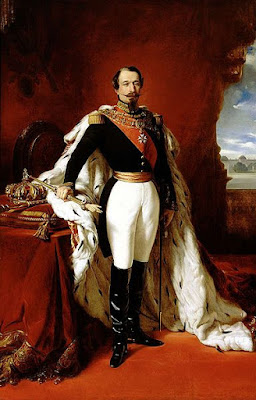


Napoleon III, Emperor of France

French newspapers demanded war. Napoleon III and his advisers burst of anger incited the French people shouting: "All to Berlin". The Prussian army invaded first the territory of Alsace, on August 4, 1870. Then, Prussians also took Lorena for their resources in coal and iron.


On July 19, 1870, Otto von Bismarck (1815–1898), architect of German unification, provoked France into declaring war against Prussia. 


On September 2, 1870, Napoleon III and 100,000 of its soldiers were taken prisoners by the Prussian army, commanded by General Helmuth von Moltke, at the Battle of Sedan.


Horseback Combat during the War


On January 19, 1871, Wilhelm I of Prussia was crowned Emperor of the Second Reich, in the Hall of Mirrors at the Palace of Versailles. Wilhelm I took the Kaiser title (equivalent to the Roman Caesar and the Russian Czar).


French Emperor Napoleon III (left) as prisoner of Bismarck (right) in the Franco-Prussian War


Wilhem I instead of annexing the whole of France, he helped to form a French republic with Adolphe Thiers as its president. One of the greatest humiliations of history!


Prussian troops marching past the Arc de Triomphe in Paris during the the Franco-Prussian War, undated illustration.


The German Empire was born because the North German Confederation became part of the new German Empire or Second Reich (Kaiserreich from 1871-1918).


sábado, 18 de julio de 2015

July 18: Today is the anniversary of the coronation of Peter II as Emperor of Brazil, in 1841.


Emperor Pedro II at age 12 wearing court dress and the Order of the Golden Fleece, 1838

He was baptized with the name of Peter Leopoldo Salvador João Carlos Bibiano Francisco Xavier de Paula Leocádio Miguel Gabriel Rafael Gonzaga. Peter II was son of Peter I of the dynasty of Braganza of Portugal. His reign lasted 58 years, between 1831 and 1889.


Pedro II at age 20 wearing court dress, 1846


Peter II Brazil took advantage of a decadent and politicized society to an orderly and progressive country, thanks to the achievement of political stability and economic growth. The key seems to be having established a constitutional monarchy and proclaiming the British Constitutional model for Brazil.


Pedro II around age 22, c.1848. This is the earliest surviving photograph of the Emperor


The reign of Peter II was victorious in three international wars: against Argentina and Uruguay in the 1850s by which prevented Uruguay to be annexed to Argentina.


Pedro II around age 25, c.1851


The second was from 1864 to 1865 when it invaded Uruguay, to intervene in the Uruguayan civil war.


Pedro II at age 46 delivering the Speech from the Throne wearing the Imperial Regalia , 1872

And the third confrontation, derived from the above, was the Paraguayan War between Argentina, Brazil, and Uruguay against Paraguay, very incited by the British Empire, to save British interests.


Pedro II at age 61, 1887: an Emperor weary of his crown and resigned to the monarchy's demise


viernes, 17 de julio de 2015

August 23: Today's date is the anniversary of the proclamation of Odoacer as "Rex Italiae" (King of Italy), by his troops, after the barbarian invasion that he led to capture Rome, in 476.


Romulus Augustus resigns the Crown (from a 19th-century illustration).

The year 476 is a milestone because it marks the end of the Western Roman Empire and the starting of Early Middle Ages.


Romulus Augustus was the last Roman emperor of the West, after the barbarian Germanic tribes invaded Rome, under the command of the barbarian Odoacer. The Romans believed that whoever was from outside the Empire, was a "barbarian!


It is important to remember that with the fall of the Western Roman Empire (based in Rome), half a century later, Justinian inherited the military Byzantine wars from his uncle, against the Sassanian Empire (second Persian Empire, today Iran).


The Germanic migrations of the 5th century were triggered by the destruction of the Gothic kingdoms by the Huns in 372–375. The city of Rome was captured and looted by the Visigoths in 410 followed by the Vandals in 455 Germanic tribes      Angles, Saxons      Franks      Goths      Visigoths     Ostrogoths      Huns      Vandals   Roman Empire      Western Empire      Eastern Empire

Justinian formed the second "Roman Empire", based in Constantinople (now Istanbul) in the hope of recovering all the territories of the old "Roman world" that he missed.


Map of the Roman empire and contemporary indigenous Europe in AD 125, showing the location of the Heruli on the Danish islands.

Odoacer was the King of the Heruli, a Germanic tribe from Scandinavia, and expelled from there and joined the Goths (another Germanic tribe) who were all called "barbarians", by Romans.


Odoacer ruled Italy between 476 and 493 when the Ostrogoths, led by Theodoric "the Great", took over the Italian peninsula, and made Ravenna, their capital.


Odoacer wanted to counter the Ostorogoths by politicking with the Pope and his entourage.


Polities in southeastern Europe c.520 AD before the Lombard destruction of the Herulian 'kingdom'


July 17: Catherine II, "The Great" Zarina assumed as Empress of Russia, after the murder of her husband Peter III.


Young Catherine soon after her arrival in Russia, by Louis Caravaque. 

Yekaterina Alexeevna or Catherine II, better known as Catherine "The Great" was the most renowned European queen and empress. Moreover, it was the queen who ruled Russia for more time and who managed to magnify Russia and make it the most powerful empire of hes time, from 1762-1796. That is 34 years.


Portrait by George Christoph Grooth of the Grand Duchess Ekaterina Alekseyevna around the time of her wedding, 1745


The reign of Catherine has gone down in history as "The Golden Age of Russia" by many accomplishments: He supported his generals to advance the Russian expansion in all geographic directions. Russia managed to extend its territory without "islands" or "teeth". It was the empire united with the territory that is more extensive mapping. In southern spread crushing the Turkish-Ottoman Empire.


Tsar Peter III reigned only six months; he died on 17 July 1762.

In the West they managed to subdue the Baltic States to Poland-Lithuania. In the East they went to Alaska and enter Russian America.


Catherine The Great by Dmitry Grigoryevich Levitsky

Catherine was his favorite nobles through which he had access to the intellectuals of French "Enlightenment".


Equestrian portrait of the Grand Duchess Yekaterina Alexeyevna

Catherine II of Russia, known as Catherine the Great, took power from 1762-1796, German princess of Anhalt-Zerbst dynasty sent to Russia to marry who would be Peter III, grandson of Peter the Great.


Catherine II of Russia by Johann Baptist von Lampi the Elder. 


Catherine entered the Russian Orthodox Church and renamed herself as Sophie Auguste by Catherine Alexeievna. She was born Sophie Friederike Auguste von Anhalt-Zerbst-Dornburg. Catherine gave a coup to her husband and was complicit in his murder. Catherine was an admirer of the Enlightenment and appointed Denis Diderot, the director of the Encyclopedia, as adviser to the queen. It won the support of landowners to carry out some reforms that his admired rationalists of the French Enlightenment suggested it.


The Inauguration of the Academy of Arts,  a painting by Valery Jacobi 


Catherine had to rely on the Russian landed gentry to develop her program of liberalization and rationalist reforms. Her system reform includes building hospitals and schools to improve the welfare of the population.

The Moscow Orphanage

However, despite the Russians shocked by her name change and her links to the Russian Church, Catherine submitted the Orthodox Church to the State and promoted French culture in the Russian Empire.


The Smolny Institute, the first Russian Institute for Noble Maidens and the first European state higher education institution for women.