miércoles, 21 de octubre de 2015

October 21: Otto IV was crowned Emperor of the Holy Roman Empire in 1209 by Pope Innocent III.


19th Century impression of Otto IV.

Innocent III called the Fourth Crusade in 1202, becoming perhaps the most terrorist of all meetings with the purpose to make the papacy of Rome an absolute ruler of Europe. Otto IV was the only king of the Welf dynasty in Germanic territories. Electors met in Cologne to name Otto as successor of Henry VI.


Otto IV and Pope Inocent III shake hands.

However, many of the electors of the Holy Empire, located in the south chose Enrique's brother, named Philip, Duke of Swabia, as the new king in 1198, after receiving gifts and promises to get elected. Some decided to follow the suggestions of the king of England, Richard the Lionheart, and opted for the Welf dynasty. Henry, Otto’s older brother, was participating in the horrific 4th crusade. The only option was Otto who was elected and crowned in Aachen (Aix-la-Chapelle) by the Archbishop of Cologne.


The choice of Otto caused a conflict between France and England, because Philip was allied with the French king Felip II; while Otto was supported by King Richard the Lionheart, and after his death by his brother John of England. When France defeated England, Otto lost his support and eventually resurfaced civil war. Pope forced a settlement between the parties but Otto Felipe refused and eventually was killed.


Otto approached the house Saufen and married Beatrix, daughter of Philip. So he approached his election and coronation as Emperor of the Holy Roman Empire to the Pope giving his full support to reconquer the Papal States which occuped at least a third of the Italian peninsula. Otto got tired of papal intrigues and decided that he would name the vacancies in the dioceses of their territories which caused the great dispute between the throne and the altar. The Pope Innocent III excommunicated Otto IV angered the November 18, 1210.


martes, 20 de octubre de 2015

October 20: Maria Theresa's throne in 1740. Bavaria Austria, France, Prussia and Saxony takes refuse to honor the Pragmatic Sanction allowing except that the daughter of the emperor of the Holy Roman Empire to the throne could not have male heir.


The main history of the war is the Pragmatic Sanction of 1713, through which the Emperor of the Holy Roman Empire, Charles IV of Austria, modify the rule to the throne and states that his daughter Maria Teresa had the right of access to the throne of Austria. Emperor Charles convinced the European monarchs to accept the agreement, but when Carlos died in 1740, Frederick the Great of Prussia ignored the agreement and invaded the Austrian province of Silesia.


“Pragmatic Sanction of Emperor Charles VI, (April 19, 1713), decree promulgated by the Holy Roman emperor Charles VI with the intent that all his Habsburg kingdoms and lands descend as an integral whole without partition. It stipulated that his undivided heritage go to his eldest son, should he have one, or, failing a son, to his eldest daughter and then, if she should die without issue, to his deceased brother Joseph I’s daughters and their descendants.” (http://global.britannica.com/topic/Pragmatic-Sanction-of-Emperor-Charles-VI)


The War of Austrian Succession began when Frederick II of Prussia invaded Silesia, on 16 December 1740. Maria Theresa, Empress of the Holy Roman Empire, sought help from the European kings who had recognized respect for her father. Nevertheless, she was not offered military support as she expected.


The Treaty of Aachen (Aix-la-Chapelle), signed on October 18, 1748, ended the "War of the Austrian Succession"; But the decision of Empress Maria Theresa of Austria to seek recovery of Silesia, led to the Seven Years' War. Maria Teresa had the support of France, Russia, Saxony and Sweden against Prussia and Britain who were allies by the Treaty of Westminster, signed in January 1756.


lunes, 19 de octubre de 2015

October 19: Ferdinand II of Aragon married Isabella I of Castile which unifies the two kingdoms into a bigger one: Spain, in 1469.


Between 1475 and 1479 the war was triggered by the succession of Castile. The outcome of the war was the union of the kingdoms of Castile and Aragon through the marriage of Kingdom heirs Ferdinand of Aragon and Isabella of Castile, who used the Roman name of Hispania as España (Spain) and there reigned together until Elizabeth's death in 1504 .


Wedding portrait of King Ferdinand II of Aragón and Queen Isabella of Castile.

Juana, the daughter of Ferdinand and Isabella of Castile inherited his mother and married Philip of Austria. Both went down in history as "Juana La Loca" and "Philip the Handsome".


Ferdinand II (1452-1516) was the son John II of Aragon; he became King of Sicily in 1468, one year before marrying Isabella, daughter of King John II of Castile.  In 1474 when Isabella became queen of Castile, Ferdinand was made co-ruler of the united Kingdoms of Castile and Aragon.  This couple was destined to change dramatically the fate of Spain. 

Felipe died in 1506 and Juana was declared incapable, so her father took over the government of Castile until his death in 1516.


Spain emerged as the most powerful and extensive kingdom in the world since 1492 with the discovery of the New World.


domingo, 18 de octubre de 2015

October 18: Today is anniversary of the end of the "War of the Austrian Succession" by signing the Treaty of Aix-la-Chapelle in 1748.


The Kingdom of Prussia was the result of the union of Brandenburg and the Polish Duchy of Prussia in 1701, led by the Brandenburg Hohenzollern family, as a result of the Treaty of Utrecht, signed in 1713, when King Frederick William I ruled until 1740, when started the War of Austrian Succession.

Frederick II of Prussia invaded Silesia, and Maria Theresa, Empress of the Holy Roman Empire (Headquarters Vienna, Austria) requested assistance from European kings but did not have the military support she expected.


There began the rivalry between Austria and Prussia, leading German nationalism and its primacy over Austria.


The Treaty of Aix-la-Chapelle, signed on October 18, 1748, ended the "War of the Austrian Succession"; but it led to the Seven Years' War, which moved to America in 1754, as a result of territorial rivalry between France and Britain for control of the territory of North America.


sábado, 17 de octubre de 2015

October 17: Today is the anniversary of the despicable assassination of General Jose Maria Cordoba in 1829.


Hero of  Ayacucho 

After his success at the Battle of Boyaca, which seals the birth of the Republic of Gran Colombia, Cordoba was commissioned by Simon Bolivar to pursue Spanish viceroy Samano, but he happened to escape alavie. Cordoba then continued to release the province of Antioquia (today in Colombia).


Jose María Cordoba


On 12 February 1820 Cordoba managed to confront the governor of the province of Antioquia Francisco Warleta, who ruled on behalf of the King of Spain. On the "White Chorros" near Santa Rosa de Osos, José María Córdoba gave Spanish Warleta such a powerful download that Warleta had to run away towards Cartagena, on the Atlantic coast. Cordoba then sealed the independence of the Province of Antioquia, and continued to free Cartagena, as well as the streambeds of Cauca and Magdalena rivers.


José María Cordoba

Cordoba travelled down to to Ecuador in order to meet Marshal Sucre on May 24, 1822 and helped win the Battle of Pichincha, by which Ecuador was liberated from the Spannish Crown.


tatue of Cordoba in Rionegro, Antioquia

Two years later it is filled with glory at the Battle of Ayacucho on December 9, 1824, when he exclaims: Soldiers, weapons at discretion; Front passage of winners! ... And he defeated the Spaniards, giving freedom to Peru. So he was nicknamed "The Hero of Ayacucho".


Statue of Cordoba in Medellín, Colombia.


The dictatorship of Bolivar angered Córdoba who fought for freedom. Unfortunately, his disagreements with Bolivar were described as conspiracy and betrayal. A crown was offered to Gran Colombia´s Liberator Simon Bolivar with the support of Louis Philippe of France, who would later become the heir of Great Colombia.


viernes, 16 de octubre de 2015

October 16: Today is the anniversary of the execution of Marie Antoinette, in 1793, for the judgments of the French Revolution.


Louise Elisabeth Vigée-Lebrun - Marie-Antoinette dit « à la Rose »

Widow of former absolute monarch Louis XVI, following his betrayal of France on October 16, 1793, Mary Antoinette of Austria was brought to the public square and guillotined before the people, causing a stir in the rest of Europe.


Marie Antoinette at the clavichord, by Franz Xaver Wagenschön (1768).


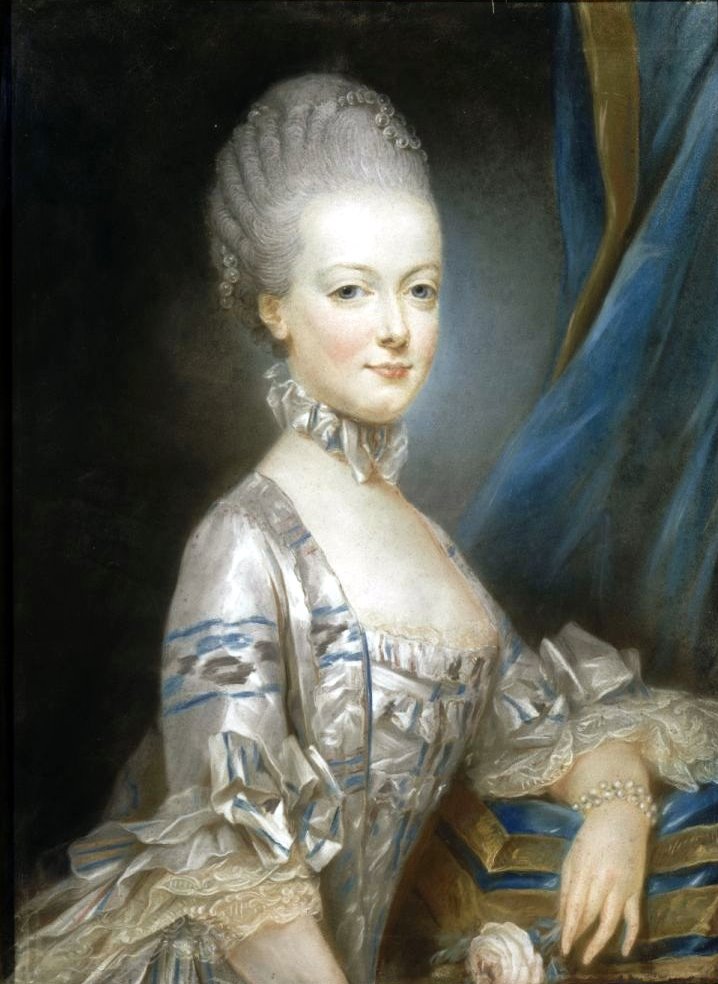
Maria Antonia Josepha Joanna of Habsburg-Lorraine, nicknamed Marie Antoinette of Austria, was Archduchess of Austria and Queen consort of France and Navarre.


Marie Antoinette, at the age of thirteen; this miniature portrait was sent to the Dauphin, for him to see what his future bride looked like. Joseph Ducreux(1769).

Many French hated the queen for being Austrian, and most of all because she had very expensive tastes, besides her frivolity. In fact, she was nicknamed "Madame Deficit" unfairly blamed for the French financial problems at the time, caused by inflation, unemployment, hunger and lack of bread.


Portrait by Jean-Baptiste Gautier Dagoty, 1775. Musée Antoine Lécuyer.

Delayed and prolonged winter wheat crop dwindled. Support for the US Civil War, as French revenge against England, did indebted to the king of France.

Arrest of the royal family at the house of the registrar of passports, at Varennes, night of 21–22 June 1791, by Thomas Falcon Marshall (1854).

When the queen was led to the gallows, the people in the square shouted insults. While Marie Antoinette climbed the ladders to the guillotine she tripped and pushed the executioner was going to decapitate minutes later. The Queen said, "Excuse me sir, I did on purpose."


Marie Antoinette's execution on 16 October 1793: Sanson, the executioner, showing Marie Antoinette's head to the people. (Anonymous, 1793. Musée Carnavalet, Paris).

Once executed by a guillotine, she and her husband nine months before, the bloody head was displayed to the people, to prove it was red blood like her husband’s instead of blue blood as people used to believe. Marie Antoinette died at the age of 38 years.


jueves, 15 de octubre de 2015

October 15: Austrians defeated the invading Ottoman Turkish Empire in 1529, and put an end to the siege of Vienna which was threatened for nearly a century by Turkish incursions into Central Europe.


The Turkish Ottoman Empire under Sultan Suleyman "The Magnificent" besieged Vienna, capital of the Holy Roman Empire, during the fall of 1529. The fear and despair of the Austrians increased by the jihad or "holy war" Suleiman declared inside the city walls. If Vienna fell into their power, then the rest of Europe would have been served on a platter.


It was a clash between Islam and Christianity. It was not a fight between Suleiman and the Habsburgs. It was seeking to subjugate all Christendom.


The Ottoman Turkish army left Constantinople with 150,000 well-armed soldiers in May 1529. His first camp was then made to move 1,500 miles in four months and stopped to rest in Belgrade, capital of Serbia today.


Suleiman the Magnificent attributed to school of Titian c.1530


On September 24, Turkish troops arrived first to Vienna. Suleiman asked to surrender the city offering life to all its inhabitants. But if refused, they would have to go to slaughter children, women and elderly until achieving a humiliating surrender.


Emperor Charles V by Titian in 1548. Alte Pinakothek, Munich, Germany

The Prefect of Vienna, Wilhelm Freiherr von Roggendorf, served as commander and defender of Vienna at the request of Emperor Charles V, who was fighting the French. The Turks had to go back to Hungary. The Holy Roman Empire survived as well as the rest of Europe.


Wilhelm von Roggendorf, austrian general