viernes, 7 de agosto de 2015

August 7: Simon Bolivar, actually general Santander, achieved the victory in the Battle of Boyacá against the Spanish in 1819, thanks to the support of Great Britain. Indeed, Latin America emancipated from Spain thanks to the ambitions of Great Britain.


Oil painting of Francisco de Paula Santander. Original is located at the House of Nariño, Bogotá, Colombia.


Today is the anniversary of Bolivar and Santander triumph against Spain in the Battle of Boyacá, on August 7, 1819. In this battle, New Granada achieved its final independence of the Spanish monarchy.


Generals Francisco de Paula Santander, from Colombia, and José Antonio Anzoátegui from Venezuela Venezuela, led the joint armies aided by the British Legion to defeat in two hours the Spanish colonels José María Barreiro and Francisco Jimenez.


Colombia celebrates the Battle of Boyaca


Simon Bolivar gave himself credit for the victory, to the British Legion. On July 25, it took place the battle of Pantano de Vargas, which managed to weaken the Spanish troops.


Statue of Francisco de Paula Santander in Medellín. 


New Granada Independence was sealed with these two battles, today Colombia. The Viceroyalty of New Granada and the Viceroyalty of Santa Fe were territories that belonged to the Spanish Empire, until the Battle of Boyacá.
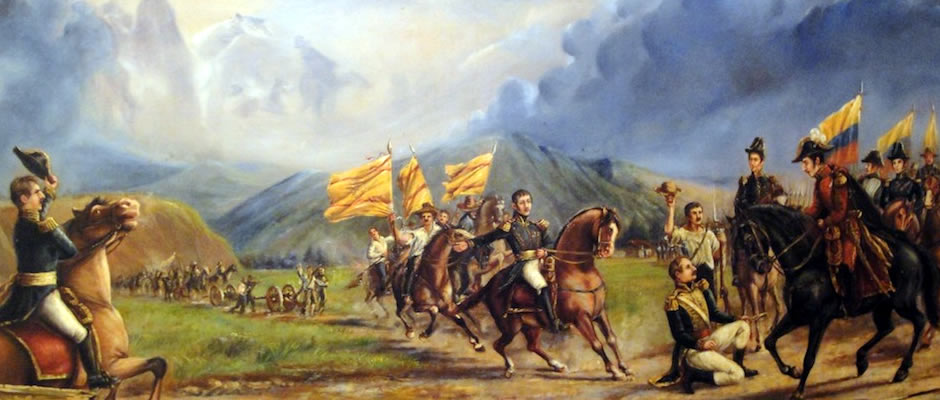

Painting of the Battle of Boyaca, which resulted in the independence of Colombia, Venezuela, Ecuador and Panama from Spain;by Martin Tovar y Tovar.


jueves, 6 de agosto de 2015

August 6: The Spanish conqueror Gonzalo Jimenez de Quesada founded Bogotá, in 1538, Capital of Colombia today.


Spanish conqueror Gonzalo Jimenez de Quesada

Today is the anniversary of the founding of Bogotá by Gonzalo Jimenez de Quesada, in 1538. The metropolitan area of Bogota today includes the municipalities of Cajica, Chia, Cota, La Calera, and Soacha, with a population of more than 8 million inhabitants that have never been told precisely by the innumerable tenements.


Santa Fe de Bogota (now days Bogota) was founded in August 6 of 1538, by a Spanish conqueror called Gonzalo Jimenez de Quesada. 


Quesada founded Bogotá with a church, where the first Catholic mass was celebrated on August 6, 1538 in what he named Santa Fe de Bogota. Quesada and his men remained in the region until the arrival in 1539 of the expeditions of Sebastian de Belalcazar coming from Ecuador, and Nicolas de Federman coming from Venezuela.


Bogota. Founded by Gonzalo Jimenez de Quesada, 1538. Engraving, 1850


The three leaders agreed to send expeditionary its territorial claims to the arbitration of the crown. Jimenez de Quesada conquered the land called New Kingdom of Granada, in honor of the city of Granada in Spain.


Map of the Republic of Colombia, nowadays


From Cartagena they sailed to Spain, where Quesada presented its requirement to be governor. Quesada returned in 1549 with the honorary title of governor of El Dorado.


miércoles, 5 de agosto de 2015

August 5: Today is anniversary of the start of the first partition of Poland in 1772 between Russia, Austria, and Prussia.


The Polish-Lithuanian Commonwealth after the First Partition (1772)

Catherine II of Russia, also known as Catherine “The Great”, Frederick II of Prussia who became known as Frederick “The Great”, and Maria Theresa of Austria made an arrangement on August, 1772, according to which half of Polish territory should be divided among the three. In fact, the partition was ratified by the Polish Sejm, one year later, in 1773.


Frederick II “the Great”, King of Prussia, aged 68

On August 5, 1772, began the first partition of Poland-Lithuania. The Russian tsarist empire, the Kingdom of Prussia (now Germany), and the Holy Roman Empire based in Austria, rivaled by those Polish territories that were necessary for the expansion.

Growth of Brandenburg-Prussia (1600–1795).

Poland-Lithuania was a failed state full of disorders, gratuities and bribed bureaucrats in high positions. The king was not elected by the "grace of God" but by vote of an assembly or Diet, every time the monarch died. The monarchy was not hereditary. That partition was a literal devouring of a country.


Catherine II by Dmitry Levitsky 

Frederick "the Great" of Prussia partition Poland was devised to prevent Austria go to war against Russia, by jealousy of victory that took the Russians against the Turkish-Ottoman Empire and gain territories.


Kaiserin Maria Theresia (HRR)

In addition of distributing Poland, the balance of power in Central Europe was reinstated among the three powers. As Poland had no defense, the Parliament ratified the partition in 1773.


Poland had no ability to defend itself. Therefore, foreign troops entered unhindered. Parliament (Sejm) had to ratify the distribution among the three powers.


martes, 4 de agosto de 2015

August 4: Today the anniversary of the invention of Champagne (Champagne) by the monk Dom Perignon, in the year 1693, and in the region of Champagne, France.


In 1718, Canon Godinot published a set of Champagne making rules, which are said to be established by Dom Pérignon. He was not fond of white grapes as they tend to enter re-fermentation; thus he said that fine wine should be made only from Pinot Nior. Dom Pérignon tried to avoid the re-fermentation process with this idea.


A Benedictine monk named Dom Pierre Perignon was the inventor of the formula or method of making champagne in the year 1693, during the seventeenth century, in the Champagne region of France.


Wine has been produced in France before Dom Pérignon. In the era of in-bottle fermentation – which gives the champagne its sparkle – the technique gave a lot of headaches to winemakers. When the weather was cold during autumn it prevented the sugars from fermenting; but during spring they started to ferment again, which meant the bottles were literally time bombs. The dormant yeast would start to produce carbon dioxide that pushed the cork out of the bottle, or worse, made the bottle itself explode. And that’s not all: it caused chain reactions and the bottles nearby would explode as well. That was both hazardous for the employees and for the year’s champagne production.


Perignon decided to go to a convent of Benedictine monks located at the Abbey of Saint-Vannes in Verdun. Then he was transferred to Hautvilliers Abbey, near Éparny. There he was responsible for managing the wine cellar of the community. Wine production doubled during his administration with admirable prosperity.


Pierre Pérignon was born to a clerk in about 1638 in the Champagne region of France. When he was 19, he joined the Benedictine monks, thus earning him the title “Dom,” and first served at the Abbey of Saint-Vannes in the town of Verdun. He transferred to the Abbey of Hautvilliers near the town of Épernay in 1668, where he served as a cellar master until he died in 1715.


Benedictine history accounts that on August 4, 1693, Dom Pierre was tasting wine bottles in the basement, and found a sparkling wine, which erupted for which he exclaimed: "Come quickly, I'm drinking stars!". The fermentation was due to sugar and the concentration of carbon gas; that was why the bottle exploded.


Statue of Dom Perignon at Möet & Chandon, France


The monk Perignon was devoted to finding ways to keep the bubbles in the bottle through a system known today as "Champenoise", hoping that the volatile gas does not escape out of the bottle and, also that it does not explode either, by avoiding pressure.


Monk Dom Perignon sommelier inventor of Champagne


Perignon managed to find an English glass and solved the problem of the cap, which was previously hardwood, but found that cork wood will solve the problem. This happened when he saw some pilgrims covering their water bottles with cork. Then he got the cork, put it to boil, and even introduced it in hot bottle necks and holding wire to seal it tightly.


Cheers!


lunes, 3 de agosto de 2015

August 3: Germany declared war on France and viceversa, contributing to the escalation of the Great War in 1914. Belgium denies permission for German Army to pass through to France.


World War I, better known as The 'Great War', began on 28th of July, 1914 with the assassination of Austrian Archduke Franz Ferdinand and his wife by a Serbian nationalist in Sarajevo. Austria-Hungary answered with the declaration of war from Austria-Hungary to Serbia. It was the first truly global war.


The “Great War” was a confrontation between the Triple Entente (Britain, France, and Russia) and the Triple Alliance (Austria-Hungary, Germany, and Italy).


On July 28, Austria-Hungary declared war on Serbia, and the tenuous peace between Europe's great powers collapsed.


However, Italy did not honor the commitment made with the Triple Alliance because Britain and France offered Italy all those territories that Italy wanted to annex in order to complete the Italian Unification. Britain and France told Italians that they will provide those territories after the victory.


The Great War ended with the Treaty of Versailles, June 28, 1919.


On 1 August 1914, Germany declared war on Russia, which makes this day, according to some, the date of the official outbreak of World War I. On 2 August 1914 Germany invaded Luxembourg and on 3 August 1914 Germany declared war on France. On 4 August 1914 Germany declared war on neutral Belgium, invading it in a flanking move designed to defeat France quickly. As a result of this invasion of Belgium, Britain declared war on Germany and Austria-Hungary. Canada followed suit and joining the war, but U.S President Woodrow Wilson declared as policy of American neutrality.


Twenty years later, on August 3, 1934, Adolf Hitler became the supreme leader of Germany to merge the offices of the presidency and the foreign ministry in one: Der Führer or "The German People's Guide spiritually, politically and militarily ".


domingo, 2 de agosto de 2015

August 2: The Meiji Reformation eliminates the samurai class, and the class system known as shinōkōshō, including teachers, artisans, small farmers and traders, in 1869. Although traditional Japanese date refers to June 25, 1869, in the Western world the date was taken as the August 2, 1869.


Emperor Meiji at age 27

Japanese Meiji Revolution began August 2, 1869, when the Japanese emperor system shinōkōshō eliminated classes, with foundations in the warmongering Samurai.
Emperor Meiji ended the Tokugawa shogunate, and sent commissioners to western countries to bring constitutional and business proposals to turn Japan into an international power.


E.R. Dumont, EMPEROR MEIJI OF JAPAN (1904). Courtesy of Library of Congress

The Meiji period elapses between 1869 and 1912: Japan emerged as a military and industrial power. Japan advanced copying Western Industrial Revolution and made a mission: "Enriching the nation and let strengthen it militarily". In many cases Japanese businesses captured markets simply by selling at a loss.


"The New Imperialism"

Recall that the Russian empire of the czars sought to "warm waters" of the Mediterranean Sea, the Yellow Sea, and Japan. To achieve the latter, it was necessary to dominate Manchuria and the Korean peninsula.


Japan: The Meiji Restoration overview


The Japanese Empire was expanding eager to release his new industrialized army. Then they saw the opportunity to face the Muscovite Bear and beat him with punishment that was the primary cause of Russian humiliation before the world.


A year after that defeat, they began the revolt against Czarist Russia. Japan emerged as a new power in the twentieth century. The Russians lasted twelve years criticizing the tsars until October 1917: The Lenin Revolution!


Review of Japanese Social Structure (Before Meiji Restoration)


But we'll see how this new power that scared in the Second World War and suddenly attacked the US at Pearl Harbor on December 7, 1941 arose.

The Japs!

Meiji Revolution!


sábado, 1 de agosto de 2015

August 1: On August 1st year 527, King Justinian assumed as the sole ruler of the Byzantine Empire.


Many people have been confused with the names of "Byzantine Empire and Eastern Roman Empire". For it is the same thing! 

Actually, the Byzantine Empire was the eastern Greek-speaking part of the Roman Empire. Roma fell to the barbarians of King Odoacer Heruli in the year 476. That is to say 51 years previously to the foundation of the Eastern Roman Empire in what was known as Byzantium, an ancient Greek colony. 


The Roman Empire was divided in AD 395 into two parts. The Western half, ruled from Rome, fell to the tribal Germanic peoples in the 5th century. The Eastern half, known as the Byzantine Empire, lasted for more than 1,000 years. Until the mid-11th century, when it began to decline in power, the Byzantine Empire was one of the leading civilizations in the world.


So today we speak of the Western Roman Empire, which fell into the hands of the barbarians, being Romulus Augustus the last Roman emperor, based in Rome.

On the other hand, the Eastern Roman territory had its capital at Constantinople, now Istanbul, Turkey. King Constantine (Roman) rebuilt the city of Byzantium and re-called it Constantinople on his behalf. 


Justinian I – r. 527-565. Born a peasant in Illyricum, he joined & was adopted by Justin in Constantinople & was well educated. He was active during his uncle’s reign. He became emperor in 527 at Justin’s death. He promoted himself as “the Emperor who never sleeps”. He married Theodora after changing the law preventing patricians from marrying outside their class. He promoted the Blue faction. When Justinian was crowned, he had Theodora crowned at the same time, & treated her as an equal.

Then, from there on, Romans began to speak of the Byzantine Empire to the eastern part of the Roman Empire. The Eastern Roman Empire or Byzantine Empire lasted until 1453 when the Ottoman Turks took Constantinople and made it their capital in the name of Istanbul.


The Baptism of Constantine painted by Raphael's pupils (1520–1524, fresco, Vatican City, Apostolic Palace); Eusebius of Caesarea records that (as was common among converts of early Christianity) Constantine delayed receiving baptism until shortly before his death.


Justinian known as "The Great," was the emperor of the Byzantine Empire from 527 to 565; that is, he ruled for 38 years.

Justinian tried to recover all the territories of the Eastern Roman Empire and more. In Rome they spoke in Latin, but in Constantinople, Byzantine Greek was spoken.


Justinian was a prolific builder: The church of San Vitale in Ravenna with precious mosaics; the Hagia Sophia, which became the world's largest to date mosque. Byzantine art was generously supported by religious mosaics, sculptures, paintings, as well as architecture.