sábado, 7 de noviembre de 2015

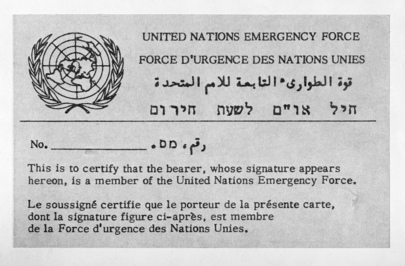
November 7: The United Nations General Assembly issued a resolution under which demanded the immediate withdrawal of Israeli, British and French troops in Egypt, during the Suez Canal crisis, on November 7, 1956.


With Napoleon's campaign in Egypt, a feasibility study was ordered to open the channel, which joined the two seas. The estimated cost is too high and the project was postponed. In 1840 he resurfaced concerns. A second study showed that the estimated costs and presented to Napoleon I, they were wrong and that the project could be viable.


The French consul in Cairo, Ferdinad Count de Lesseps, was enthusiastic about the project and founded the Compagnie Universelle du Canal Maritime de Suez, with support of the French emperor, Napoleon III. Works began In 1859, through a 22% capital contribution by Mohammed Said Pasha, and the remaining 78% by French investors.


On November 16, 1869, Lesseps finished building the opened canal. The inauguration took place the next day. In late 1875, Benjamin Disraeli, who served as Prime Minister of Great Britain for the second time, acquired a 44% stake in the channel, in favor of the English crown by a money move on the Stock Exchange. The Egyptian debt had climbed and Disraeli took the change of buying Egyptian external debt stock of the Canal, and the rest was acquired from the French through the same stock exchange.


The Suez Canal Crisis was also known as the Sinai War. It was a massive Israeli invasion of Egypt which had the joint support of Britain and France, because Egyptian President Gamal Abdel Nasser nationalized the Suez Canal, which belonged to Britain.


First, Egypt blocked the passage of ships loaded with oil from Saudi Arabia and the Emirates towards Israel, Europe and the United States.


Britain had controlled the canal after France built it. Israel was increasingly threatened by a possible Egyptian invasion, with the help of the Soviet Union. Israel invaded Egypt and the next day France and Britain issued a joint statement to Nassar of Eygipt and began to bomb Cairo.


Israel was very efficient in achieving their military objectives. The Anglo-French forces withdrew by the end of the year. The Soviet Union and the United States forced the withdrawal of troops from the triple aggression and Assembly of the United Nations issued its resolution. Israel stayed until March 1957 prolonging the crisis. In April, Nassar ordered to open the channel again. Almost a global nuclear war could havae been unleashed.


viernes, 6 de noviembre de 2015

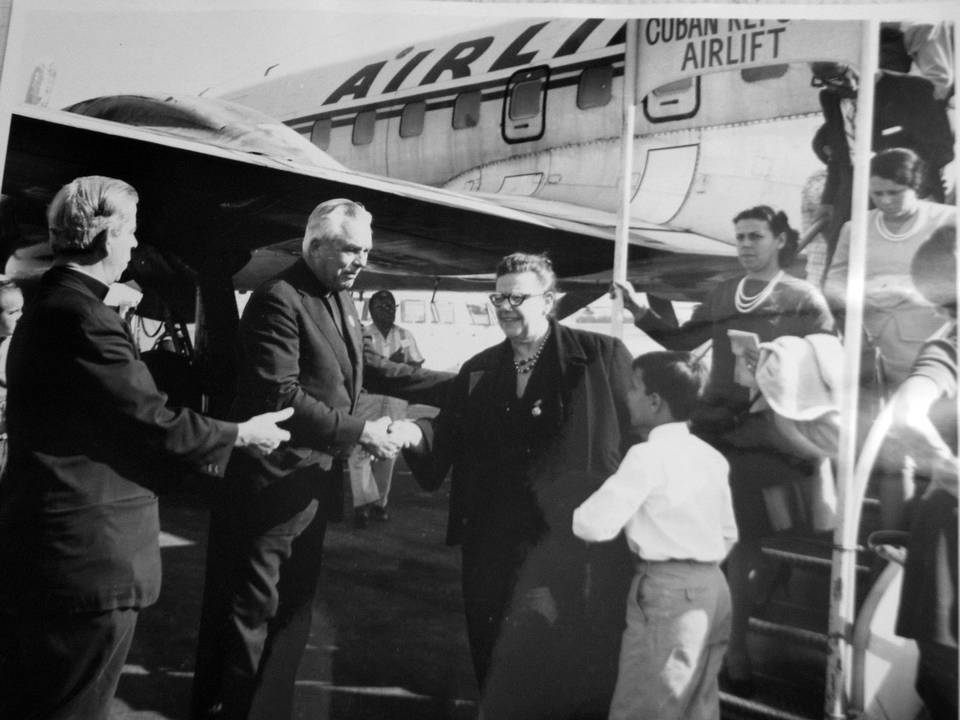
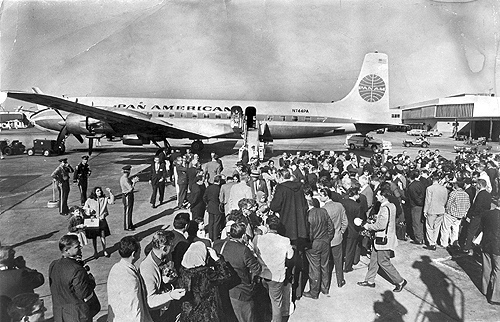
.November 6: Today is the anniversary of the execution of the agreement between the US and Cuba to evacuate all Cubans who wanted to leave the island by Pan american Air, in 1965. They began the "Freedom Flights".


Freedom Flights (known in Spanish as Los vuelos de la libertad) transported Cubans to Miami twice daily, five times per week from 1965 to 1973. Its budget was about $12 million and it brought an estimated 300,000 refugees, making it the "largest airborne refugee operation in American history".


More than 500,000 Cubans accepted the US invitation and flew to Miami, between 1965 and 1971.The Cuban Revolution that began in 1953 and ended in 1959 say, but it was not a change of power.


Freedom Flights. ( Puente Aereo ) | by ROGALI

In Cuba there was an armed insurgency led by Fidel Castro and his "July 26 Movement" against President Fulgencio Batista dictator of Cuba. The rebels who fought against the regime of Fulgencio Batista in Cuba, took the Sierra Maestra and proclaimed a popular uprising against the regime.

... a photo of Cuban exiles arriving at Miami International Airport on the first Freedom Flight on Dec. 1, 1965. The twice-a-day Freedom Flights ...


On 1 January 1959, Fidel Castro captured Santa Clara and Batista had to flee into exile in Portugal. January 8 next, Castro and his forces entered Havana.


Cuban refugees disimbarked from a chartered DC8 in a program that brought 1,000 Cubans a week in what became known as the Freedom Flights. Here they are greeted at Miami International Airport by immigration workers assigned to make feel welcome in the late 1960’s.


After the missile crisis in 1962, agreement was reached to evacuate Cubans wishing and US undertook not continue "supporting" the anti-Castro on the island, on November 6, 1965.


... a photo of Cuban exiles arriving at Miami International Airport on the first Freedom Flight on Dec. 1, 1965. The twice-a-day Freedom Flights ...


November 3: The French had to chicken out in 1898 during the "Fashoda incident" in what is now Sudan, Africa. British Empire warned the nosy French and threatened them war.


The Fashoda Incident 1898: Central and east Africa, 1898, during the Fashoda Incident.


The "division of Africa" ​​between Britain and France created the envy of Germany and Italy for African resources and markets needed for industrialization. Railroads should go west to the Red Sea, according to the French. Nevertheless, the British entrepreneur Cecil Rhodes had already traced his route from the south to Egypt, to take all of Africa.


In 1895, Theophile Delcasse was appointed French Minister of Foreign Affairs. He opposed German politics and wanted a diplomatic negotiation with Britain.


However, in 1898 there was a territorial dispute, known as the Fashoda Incident between France and Britain, in what is now Sudan to the east of Africa.


Delcessé ceded in favor of Great Britain because he just chickened out. That "diplomatic move" served to advance other agreements with the British Empire. Eventually, in 1904, the French achieved a cordial understanding with the British (Entante Cordial, for French and Cordial Understanding for the British).


In 1907, the British favored a deal with the Russians which is known as the Triple Entante formed by France, Britain and Russia as a military alliance. Therefore, two blos were formed to balance powered in Europe Europe: The Triple Alliance and the Triple Entante.


The First World War was brewing.


jueves, 5 de noviembre de 2015

November 5: On November 5, 1757, Frederick "the Great" of Prussia defeated the allied armies of France and the Holy Roman Empire of Austria at the Battle of Rossbach, during the Seven Years' War.

Frederick II (the Great), King of Prussia, aged 68

Seven Years' War definition can be summarized in the non-acceptance and lack of honor to allow a woman to rule the Holy Roman Empire. As a result a new struggle for power in Europe began between 1756 and 1763, in order to establish control over Austria that lost Silesia in favor of Prussia.


Añadir leFrederick the Great closes the trap. Red represents the French and Austrian army.


It is pertinent to say that the war in question should be recognized as the First World War, because its battles took place in Europe, America, Asia, West Africa, India and the Philippines: It was a global war.


Frederick II, nicknamed "The Great" was King of Prussia and admired for his brilliance in military campaigns as well as his expertise to organize of the Prussian armies. When Frederick assumed the throne of Prussia, he attacked Austria and claimed Silesia, which launched him to fame as a military strategist.


5 November 1757 – Battle of Rossbach – Seven Years War

Frederick took advantage of the Holy Roman Empire ruled by Maria Theresa of Austria, who had no support from other European monarchies, nor of her own generals who were ashamed to undergo a woman.

As you can see areas of conflict can be found in the maps of the campaign of "Empire Total War".

The antagonisms between Prussia´s Hohenzollern dynasty, the Habsburg dynasty and the houses of Bourbon in France and Spain were in constant conflict of territorial interests worldwide. Actually, the Seven Years’ War was a global war.


All the participants of the Seven Years' War.   Great Britain, Prussia, Portugal, with allies   France, Spain, Austria, Russia, Sweden with allies.


miércoles, 4 de noviembre de 2015

November 4: Today is anniversary of the day Chevrolet cars entered the US market to compete with the Ford Model T in 1911.


1911 Chevrolet Series C Classic Six was the first model Chevrolet sold.

The "Classic Six" was the first car to carry the Chevrolet brand since US William C. Durant and a Swiss-French Louis Chevrolet, joined forces to create a company car manufacturing, using the brand name of the then famous racing driver Swiss: Chevrolet. The company was called Chevrolet Motor Car Company.


Chevrolet Classic Six 1911-1912

William Crapo "Billy" Durant was the founder of General Motors as well as the system of multi-brand strategy services, more popularly known in the US as "Chevy".


Etienne Planche had actually designed the Classic Six under Louis Chevrolet´s direction.


Billy Durant used the company in his favor to acquire majority stake in General Motors.

The very first Chevrolet, the Classic 6, which was unveiled on the 3rd November, 1911.

Durant's successor, Alfred Sloan, converted Chevrolet Division as one of General Motors Corporation. Sloan gave his maxim: "a car for every purse and purpose" with which he boosted sales to achieve sales targets and exceed his successful rival Henry Ford’s Model T. In 1929, General Motors surpassed Ford in sales.


Louis Joseph Chevrolet


lunes, 2 de noviembre de 2015

November 2: Today is the anniversary of the Balfour Declaration in 1917, by which Great Britain supported the establishment of a national home for the Jewish people in Palestine.


Portrait of Lord Balfour, along with his famous declaration: His Majesty's government view with favour the establishment in Palestine of a national home for the Jewish people, and will use their best endeavours to facilitate the achievement of this object, it being clearly understood that nothing shall be done which may prejudice the civil and religious rights of existing non-Jewish communities in Palestine, or the rights and political status enjoyed by Jews in any other country.

The Balfour Declaration was actually a letter dated November 2, 1917 letter written by the Foreign Secretary of the United Kingdom, Arthur Balfour, Walter Rothschild, 2nd Baron de Rothchild and leader of the Jewish community in Britain in order to be transmitted to the Zionist Federation of Great Britain and Ireland.


The text of the letter was published a week later, on November 9, 1917 with the title "Balfour Declaration", which was later incorporated into the Treaty of Sevres with the Turkish Ottoman Empire and the mandate was Britain on Palestine.


The text was approved by the US government previously.


The Balfour Declaration became the Mandate of Great Britain's Partitioning Plan for the Middle East land that had been defined as Palestine.


Although the publication of the text was scheduled for Christmas because it was assumed that by that time had already been taken fully into Palestine, he managed to slip to the press.


domingo, 1 de noviembre de 2015

November 1: The Pope Julius II was elected in 1503.


Pope Julius II, by Raphael. National Gallery, London.


Giulliano della Rovere was elected Supreme Pontiff of the Catholic Church on November 1st, 1503. He adopted the name of Julius II and was nicknamed "The warrior Pope ", also called "The Dread Pope" because he was short-tempered. He often he argued with Michelangelo over his delays in his fresh paint jobs assigned at the Vatican.


Michelangelo Buonarroti


The papacy of Julius II was characterized by his active foreign policy, the ambitious construction projects and his unqualified support for the arts. The Pope ordered the destruction of the ancient basilica and ordered the construction of the new St. Peter's Basilica. He also hired Michelangelo to decorate the ceiling of the Sistine Chapel.


The Sistine Chapel ceiling paintings by Michelangelo were commissioned by Pope Julius II in 1508.

Despite the political and military achievements of Julius II, the main title of honor is found in his patronage of art and literature. In 1506 he laid the first stone of the new St. Peter's Basilica.


The Creation of Adam by Michelangelo


The Pope was a friend, admirer and patron of Bramante, Michelangelo and Raphael artists. So he empowered them to beautify the Vatican and much of the city of Rome.